The Built Environment: the Skyline as an Energy Artifact

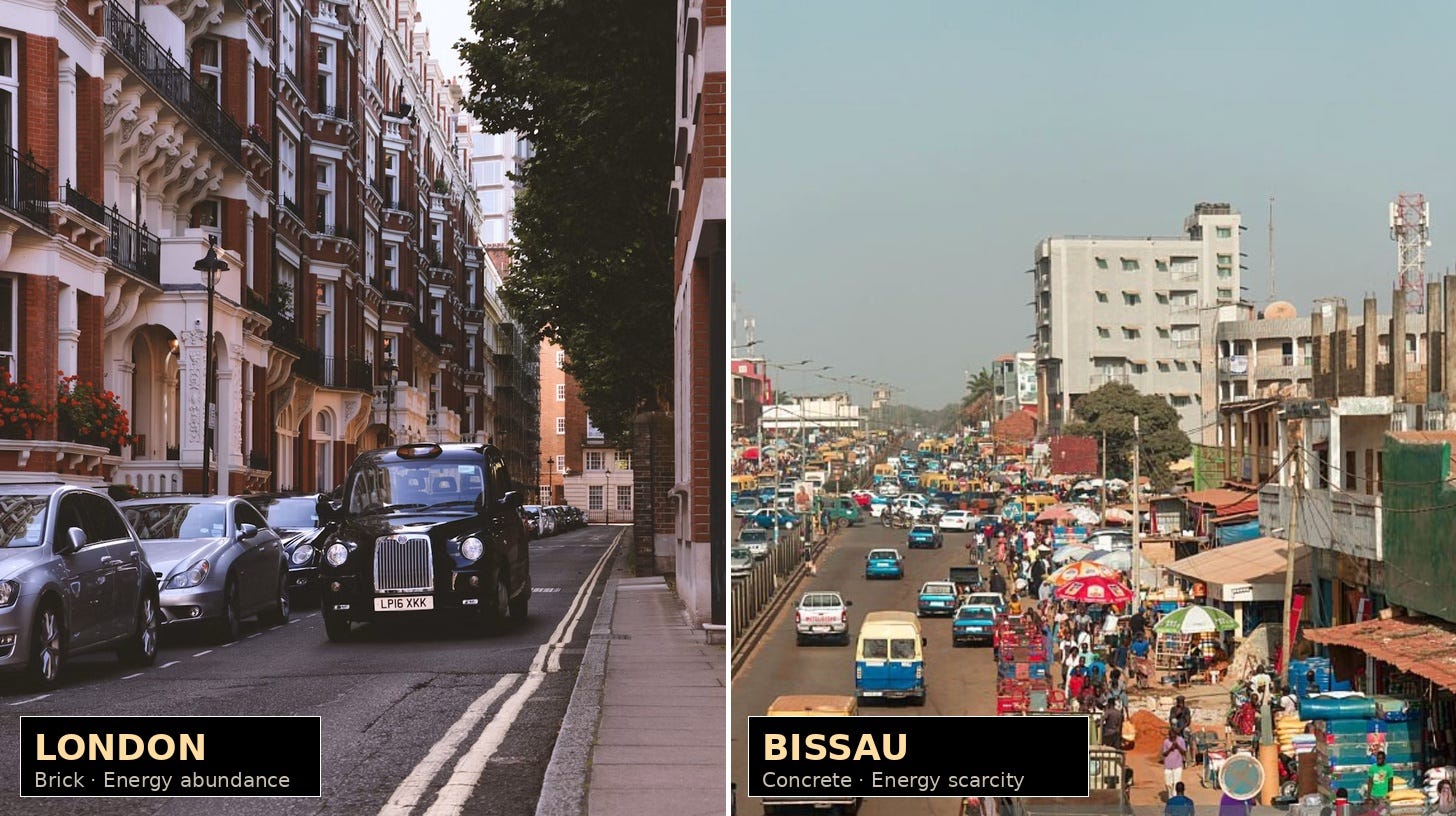
Earlier in the year, a group of us were in Rabat, Morocco for a “Growth Summit.” It was a departure from the usual conference circuit—sharp disagreement on the drivers of growth, but alignment on the necessity of pursuing it,especially in Africa. I was with the group that stayed on the Mohammed VI Polytechnic University campus, a beautiful campus, where the buildings are predominantly built with bricks. On the return trip, I passed through London, where brick defines entire neighborhoods—rows of houses uniform in texture and color. I wondered why across Africa we don’t see as many brick buildings, even in parts of the continent where the climate is amenable to brick. So I looked into it. I found out that while it is easy to read these building materials as mere aesthetics, we should see them as what they are: a function of energy abundance.
Brick, it turns out, is not a “traditional” material in the sense people assume. It is an industrial product. To turn clay into brick requires sustained heat—kilns run at roughly 1,000°C, reliably, repeatedly, at scale. That cycle is impossible absent cheap and dependable energy. Europe’s built environment reflects centuries of that condition: coal, then gas, then stable electricity systems that made high-temperature industrial processes routine. Brick became abundant, standardized, and therefore ordinary.
Where that energy condition does not exist, the material palette reflects it. Much of Africa builds with concrete block, laterite, timber, and sheet metal. This is primarily an adaptation to energy constraints. Mixing cement, sand and water to create cement blocks requires lower energy inputs than converting clay and water to a brick in a kiln. Building with cement blocks tolerates fragmented, small-scale production. It fits an environment where power is expensive, unreliable, or both.
Energy systems do not just power factories and homes; they determine what can be manufactured in the first place.
Energy systems do not just power factories and homes; they determine what can be manufactured in the first place. Energy defines the built environment. It is central to modernity. The difference between a brick row house in London and a block structure in Bissau is the downstream expression of upstream energy economics.
This realization extends further than materials. When energy is cheap and reliable, production centralizes. Standards emerge and inputs become uniform. Builders design around predictable materials, and entire construction ecosystems—codes, training, finance—align around that stability. When energy is scarce or volatile, the system fragments. Materials are produced in smaller batches, with greater variability. Fragmentation in the built environment becomes not just a social condition but a technical one and urban form reflects this. High-rise construction depends on energy-intensive materials: steel, high-grade cement, glass. Where energy systems cannot support those industries at scale, cities grow outward and incrementally. Building vertically requires energy-dense material supply chains: the skyline is an energy artifact.
In development discourse today, energy continues to be misclassified—treated largely as a social good to be distributed, and simply another input among many, important for firms, critical for households, but ultimately one sector among others. This is evident in the development community’s obsession with counting connections; an outlook built into development practice. But counting connections tells you nothing about whether a country can fire a brick. Power sits upstream of the entire material economy. It determines whether a country can produce steel or must import it, whether it can fire bricks or must substitute, whether it can standardize construction or rely on improvisation. Governments, whose economies depend most directly on whether the energy sector works, are better positioned to force this reorientation than other development actors—and it is their responsibility to do so.
These governments should first stop misdiagnosing the problem as supply. A supply-oriented energy policy defaults to adding generation and expanding networks, but the constraint is not just capacity. Many utilities are insolvent and poorly governed; the sector is not organized to deliver reliable power. The binding issue is organizational—utilities that do not recover costs do not maintain assets, mandates are blurred, and reliability fragments—so added capacity does not translate into usable power. Expanding generation and networks without fixing these conditions is capital destruction.
Expanding generation and networks without fixing these conditions is capital destruction.
The brick houses in London–and across the United States and Europe–mark where cheap, reliable energy has long been in surplus, just as the concrete and corrugated metal buildings across your average African city mark its chronic absence. Until that condition changes across the continent, the built environment in Africa will continue to reflect that absence–as will its economies and livelihoods.
The point about embodied energy of building materials is interesting, but we should be cautious with the characterisation of brick production as a large-scale "industrial" process. Just take the case of India, where plenty of rudimentary brick kilns dot the rural landscape. In this context, brick very much "tolerates fragmented, small-scale production."
Rabat’s skyline is bankrolled by Gulf sovereign funds. Growth summit debate is theatre while Ed-Doha’s glass towers idle at 30 occupancy.